Looking For a Common Security Architecture for South Asia
📝
🕐 2022-08-23 19:54:26

Air Vice Marshal Mahmud Hussain (Retd)

The history of South Asia is linked with a rich colonial and foreign experience through British and Mughal rule of about 500 years. The vastness of South Asia has made it a composition of discrete socio-cultural units based on numerous ethnic communities. Despite the salience of differences in religion, language, culture and character of diverse nations within its physical limits, it features on the world atlas as a distinct geographical region, separated from the rest of Asia. This vast region comprising ——- Afghanistan, Bangladesh, Bhutan, India, Maldives, Nepal, Pakistan and Sri Lanka ——- with its multi-ethnic demographic configuration conjures up the world’s most interesting political narrative. The unity which the ruling Mughal and the British empires imposed on the subject peoples of South Asia was artificially drawn for political dominion and economic exploitation.
The term “Indian Sub-continent” and “South Asia” are, sometimes, used synonymously. This notion of placing “India” as a pre-fix convolutes the way an ordinary intellect today views South Asia as a political entity. The Indian sub-continent, which was a political reality of British Empire, composed of present-day Bangladesh, India, Pakistan and Burma (modern day, Myanmar). So, for easier comprehension, the term “South Asia” must include all states that fold within the physical geography of a defined region. It is a fact that Bangladesh, India and Pakistan form the core of South Asia with the migration of Myanmar to South-East Asian community. India is the dominant state in the centre. It is the modern states of the past Indian sub-continent that have suffered the greatest casualty in terms of identity crisis.
In this paper, I will be narrowly focused, and mainly use the term “South Asia” for Bangladesh, India and Pakistan. Since the regional security architecture is very wide and complex given the modern extensive role of traditional and non-traditional security challenges, I will be parsimonious by addressing only the following common issues within the limited space of permissibility:
1. The Communitarian Dilemma of South Asian politics
2. The Centrality of India
3. Strategic Game of South Asian politics
4. Non-traditional Security Challenges
5. Synthesizing Security Agenda
6. Conclusion
The Communitarian Crisis of
South Asian Politics
Constructing “imagined communities” may be a basis for conflict or discriminatory violence; and the security of a citizen is frequently threatened by his own governments when he belongs to a particular religion or a nation to which the ruling class displays an abject corrosive behavior. This behavior is a particular society’s manifestation of dementia praecox superimposed upon other societies through its stronger representation of political power. Three examples from history will suffice to show the baseness of politics in debasing particular communities in South Asia —- two are little older, and the third one is recent.
The partition of India in 1947 shows the dark forces of domestic politics. Partition resulted in 14 million refugees, and killing of over one million people —- 8.6 million Muslims and 5.3 million Hindus. India and Pakistan have fought four major wars. The fin-de-siecle of “one Muslim State and Nationhood” embodied in the theory of Pakistan came to an end with the emergence of Bangladesh in 1971 War. From “Muslim East Bengal” of United India, it became “Muslim East Pakistan” and when it split from Pakistan, it became Bangladesh. The flesh of partition proved Shylock’s dream of butchering a bloodless meat wrong by spilling blood in out of proportion on pages of a smearing history.
The destruction of the Babri Mosque in 1992 is the other example of how religious identity becomes a victim. India is constitutionally secular, but the political power has succeeded to construct a myth that defeats reason. The final judgement of Allahabad High Court to allow Hindus to build a temple on the ruins of Babri Masjid is an example of fear besetting an independent judiciary.
The third example is the implementation of National Register of Citizens (NRC) and the Citizenship Amendment Act (CAA), 2019 fuels tension in Indo-Neighbours relationship. The Act also brings to question how the Indian government sees a particular community as different. The idea of Hindutva as co-eval with “India as a nation-state of the Hindus” suggests an obsession with ancient mythic literatures. It seems so strangely myopic when pitted against the beautiful song meant as an ode to Hindustan embodying the land comprising present-day Bangladesh, India and Pakistan titled Taranah-e-Hindi by poet Allama Iqbal, a Muslim:
“Sare jahan se accha, Hindostan Hamara;
Ham bulbulen hain is ki, yin gulistan hamara.”
Translation:
“Better than the entire world, is our Hindustan,
We are its nightingales, and it is our garden abode.”
However, the problem of “communitarian violence” is not limited to India only. For Pakistan, islamization revolves around the problem of ethno-centricity. After the birth of Pakistan, Bengalis were turned into an object of anathema. For 25 years, Pakistan’s history constituted a conflict and clash of internecine politics. The independence of Bangladesh is soaked into the blood of martyrs, and whenever the question of Bangladesh-Pakistan comes up, the history emerges as a poignant cudgel of faux paus striking at the dumb rationality of conceiving a united Pakistan on the basis of religion.
The discourse of a secular Bangladesh is also debilitated by ambivalent political maneuverings. The tensions in communitarian lines emanate from vague assessment of national identity and its propensity towards promoting the difference between ‘we’ and ‘other’. The difference is due to the failing of comprehension of lucid moments of history in its fit to attribute to it the role of a myth-making mission instead of a national philosophical unity.

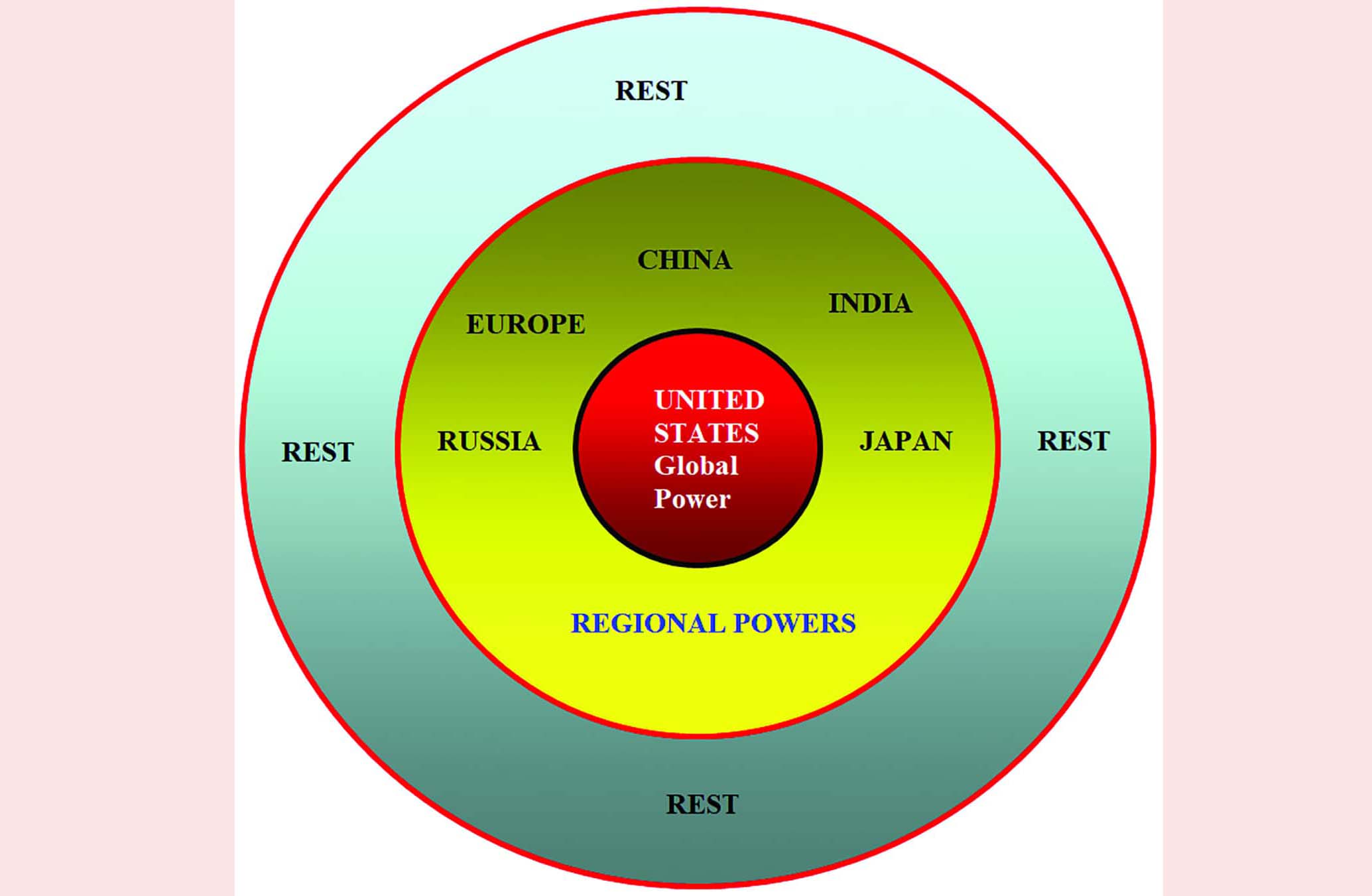
FIGURE 1: STRATEGIC MODEL FOR
UNIPOLAR-MULTIPOLAR WORLD
(Source: Author’s Own Formulation)
The Centrality of India
Indians prefer to admit that post-Cold War era is uni-multipolar. The most powerful in the global order is the United States. Europe, China, Russia, Japan and India will fall in the second category. Though Japan is an exception, given its history, its “will to power” may resurface on the sheer strength of its economic power. The rest of the states will make for the third category as they are incapable to will their power beyond their own territory. Thus, the uni-multipolar order presents us with a strategic model of concentric circles. The core circle is dominated by the United States. Its influence stretches to the periphery of the outermost ring. The second circle belongs to the states capable of exercising regional hegemony. Their outward influence depends on the region they dominate. For example, in South Asia, it is Indo-centric, and strategic-regional power emanates from India being in the centre. The most important feature of this model is that if the core is cracked, the “Balance of Power” system becomes brittle either at regional or global level.

FIGURE 2: INDIA REPRODUCING UNIPOLARITY IN SOUTH ASIA
(Source: Author’s Own Compilation)
In November 2017, the Foreign Affairs magazine brought out a special supplement on India’s 70th anniversary of independence. In one of the articles, the writer points out the time when the world started to take notice of India’s rise to power. It was when President George W. Bush signed a nuclear pact with New Delhi in July 2005. This strategic move in US foreign policy was indicative of a breakthrough in global politics in the post-Cold War period. There has also been a radical change in India’s attitude after being accorded “global power” status by the Bush administration. The United States, being the only superpower, finally recognized India as a power to reckon with. India could be used as a “swing state” in the balance of power against China. But Indian policy makers are also aware of its limitations, and therefore, in the foreseeable future, intend to limit its influence in the immediate South Asian neighbourhood. This may be seen as “India reproducing unipolarity at the sub-regional level” of the Indo-Pacific region.
Most Indians perceive strong relationship between the United States and Pakistan as an irritant to India’s place as a benign and legitimate unipolar power in South Asia. In a purely unipolar world, there are other contenders to compete for US favour, and consequently, India is a loser. So, India would prefer a uni-multipolar world order, so that it can foster stronger ties with the United States in protecting its geo-strategic interests. A unipolar South Asia with India at the centre is the ideal state of India’s dream in global politics. This strategic ambition is what gives India its manifest doctrine.
But India’s position as South Asia’s number one power is not without die-hard challenges. Pakistan is its arch-rival from within the region, and China its greatest challenger to great power status in world politics. This reckoning brings us to the grand chessboard of
South Asian power politics.
Strategic Game of South Asian Politics
The Pakistan-India-China-US quadrangle signifies important geo-political and geo-strategic dynamics in South Asia with far-reaching consequences for international relations. In the post-Cold War era, the rise of China both as military and economic power is a shift in great power politics in Asia. China’s overt ambition is to engage in greater volume of trade, infra-structural development and arms supply with other states. China’s bilateral economic exchange is much stronger and robust with South Asia than it was before. The United States intends India to stand in opposition to China. Pakistan holds a sensitive geo-strategic location for the United States in the fight against terrorism fortifying US presence in the region to countervail China. On the other hand, China’s support to Pakistan is a balancing act to checkmate India from envisaging a “Unipolar South Asia”.
The geo-political scenario suggests that the four states can simply be drawn as a quadrangle, in which it is possible to draw a line between all pairs of countries. The countries are called “nodes”, and the relationship as “edges”. There are then six possible edges and four possible triangles to consider stability and harmony of the strategic outcome of South Asia.
In the South Asian chessboard of Pakistan-India-China-US quadrangle, the US-India ties will reinforce China’s ties with Pakistan. However, these pairs of relationship will be mutually complementary and will produce a stable pattern of alliances. Though stability is 4/4=1, but harmony is only 2/6=1/3. Stability is defined as a condition of equilibrium, while harmony indicates the magnitude of agreement or disagreement regarding maintenance of institutional rules among constituent elements. This is one of the reasons that despite a stable situation, the overall political situation in South Asia is tense. Both India and Pakistan have nuclear weapons and have not refrained from increasing their arms competition, and their border clashes are symptoms of historical atavism. Unless Kashmir issue is solved, and though war against terror has pushed the United States into working with Pakistan, the factor of China in this complex web of relationships produces greater US tilting toward India to conform to the essential rule of post-Cold War unipolar order which is for the United States “act as globally and multilaterally as possible to contain the rise of a recalcitrant hegemon”.
Therefore, strategically we see that there are two major exogenous actors: US and China that are embedded in regional security architecture. It is not only India and Pakistan are in their game-theoretic model; other South Asian countries including Bangladesh are also affected by their power play. The birth of Bangladesh is a fine example where the game played by the great powers, ——- the United States, China, the Soviet Union and India ——- demonstrated the inevitability of power play of a bi-polar international system. So, China and the United States will be common strategic inputs for South Asia in the foreseeable future.
In the preceding paragraphs, our interest has been on the strategic aspect of South Asian geo-politics. Intra-regional politics of South Asia has failed to engage component states meaningfully in intra-regional trade. There is minimal volume of trade conducted within South Asia than outside the region by individual states. Intra-regional trade at less than 5 percent makes it the least integrated region in the world. ASEAN has 25 percent, East Asia 35 percent and Europe 60 percent. It is 20 percent cheaper for India to trade with Brazil than with its neighbour Pakistan. In recent times, Bangladesh, India, Nepal and Bhutan have been among the top ten in GDP growth; yet this does not carry much significance in regional integration unless bolstered by institutional framework to address common economic security challenges. That is why while Figure 3 speaks of an appreciable regional stability at 1, regional harmony lapses into a miserable 1/3. The contrast is a proof of the region’s failure in building trust and confidence amongst the governments, though SAARC is a readymade vehicle for economic cooperation and if need be, integration by making use of which South Asia can be shaped into a political harmony in future.
Security Challenges
South Asia is poor and weak. Its greatest security challenge is poverty. According to Global Multi-Dimensional Poverty Index report prepared by the United Nations Development Programme (UNDP) and the Oxford Poverty and Human Development Initiative, South Asia offers a dismal common regional human development architecture.

FIGURE 3:
GEO-POLITICS OF SOUTH ASIA
(Source: Author’s Own Compilation)
Out of 141 countries, India’s position is 68th, Bangladesh 105th, Nepal 108th and Pakistan 110th. India trails China by 40 places at 28th. Economic security underwrites the condition of human security. Human security takes into account the entire spectrum of security challenges. Insecurity should be understood from a wide range of threats. When these threats become trans-border, the states which exist within a defined region, become fragile. These fragile regions persist, but their existence does not mean vitality. They produce a wide range of intra-regional security challenges, such as, poverty, famine, hunger, terrorism, corruption, human trafficking, illiteracy, state-sponsored ethnic-cleansing, exploitation of migrant workers and so on. For a weak region, the realities of inter-state security challenges become the testing ground for regional institutional stability and harmony. The spectrum of common security challenges for South Asia is shown below:
Synthesizing Security Agenda for South Asia
So, where do we start in South Asia to bring the measurements of stability and harmony at close to each other or at the same level? One of the starting points is to carry out self-reflection. This can start at the point of taking Sustainable Development Goals (SDGs) as regional Security Imperative. The 17 SDGs have fixed 169 targets with 232 indicators. These targets are holistic and define “National Security Strategy”, and they embrace the functions of the executive, the legislature and the judiciary. Let us see the performance of SDG implementation in South Asia.

FIGURE 4: GLOBAL MULTI-DIMENSIONAL POVERTY INDEX 2018
(Source: UNDP & Oxford Poverty and Human Development Initiative)
The results of SDG implementation do not say much to the credit of South Asia. Excepting for poverty reduction and “no hunger”, the results are not satisfactory in other goals. So, the most significant issue for the policy makers for synthesizing security agenda is to address the emancipatory role of human security in the life of South Asian citizens. Strong institutions and regimes ensure justice, rule of law and good governance both at state and regional levels.

FIGURE 5: SECURITY
THREATS TO SOUTH ASIA
(Source: Author’s Own Compilation)
Hence, the following actions become expedient in understanding the issues of regional security architecture, and building a cooperative security framework in South Asia:
The region should revive SAARC as a vital economic forum and strengthen intra-regional trade.
2. The leaders and bureaucracy of South Asia should work together for the implementation of SDGs as a regional cooperative security initiative.
3. The region should focus collectively on “poverty reduction” as the most significant common security issue.
4. The leaders of South Asia should address non-traditional security challenges, such as terrorism, human trafficking, trans-national crime both at bilateral and multi-lateral levels by forming institutions.
5. The leaders must address the challenges of communitarian mind-set both at domestic and regional politics.
The leaders of South Asia must be aware of external great powers from becoming a threat to national and regional stability.
Conclusion
No state can guarantee peace and security to its people in isolation. Its well-being is affected and sharpened by the upheavals of the environment within which it sustains the life of its citizens. A state is but an atom within the complex international system whose character affects its own fate for better or worse. When a state looks beyond its border, it sees a different country with features not exactly its own. With such complex national and sociological diversities surrounding its existence, a state learns to live in a setting of mutual co-habitation. But the quirky side of living together is experienced by the state in its conduct and response from other states in the international system.

FIGURE 6: SDG IMPLEMENTATION; SOUTH ASIA
(Source: Planning Ministry, GOB, June 2020)
States are also not similar in their possession of power, either political or economic. So, the nature of hegemonic immanence is to be accepted, in varying degrees of strength, in the structure of regional or global order. Order is nothing but an arrangement of things necessary for order’s function as an effective organization. When a powerful state within a region leapfrogs its regional expedient to seek a higher level of advantage at global scale, it damages Order’s principle of faithful co-habitation. That is why, it is necessary for leaders to comprehend the socio-cultural dimensions of regional politics in order to promote and expand the networks for securing Order’s principle of faithful co-habitation.
In this short essay on Security Architecture for South Asia, what becomes clear is that non-traditional insecurities are even more significant than traditional military challenges because the former is concerned with an individual citizen’s well-being while the latter is about an individual state’s fear of other states’ military threat. One is the question of a human’s security from numerous threats while the other is a matter of pride for a state to be or not to be under the bully of a hegemon. One is about “human security”, while the other is “state security”. It is easily premised that state security in order to fortify its bricks of ordering arrangement must contain human security as the first precept of foundation. The same principle can be elevated from the state level to the regional level. It is by giving non-traditional human security challenges a regional institutional obligation that a region will fulfill a utilitarian purpose to its common security architecture. We can only create an effective regional security framework to work on when we are able to realize the value of individual man above the self-fulfilling prophecies of national history. Poverty is a common problem of all, not a problem of a particular community in South Asia. It lacks vision when states opt out of cooperation on non-traditional insecurities because their militaries are arch rivals. The crisis of South Asia, at this juncture, is not so much the armies of individual states but the majoritarian influence on their individual governments to limit the space of “Identityship” of citizens, thereby artificially creating an internecine atmosphere of “Communitarian Crisis”.
The project of building a reliable security architecture for South Asia will ever remain unfulfilled, so long a man feels that the state in which he lives does not own him or his state of poverty is never-ending. But the few actions enumerated in the above section require strong collective regional leadership, at bureaucratic and political levels, capable of crystallizing the areas of conflict in clear and unambiguous terms, and giving meaningful potential to people to people actions through SAARC.
Air Vice Marshal Mahmud Hussain is a retired air force officer. He served as High Commissioner of Bangladesh to Brunei Darussalam from November 2016 to September 2020. He served as the Chairman, Civil Aviation Authority of Bangladesh (CAAB). Presently, he is working as the Distinguished Expert at Bangabandhu Sheikh Mujibur Rahman Aviation and Aerospace University (BSMRAAU).




More News From This Category