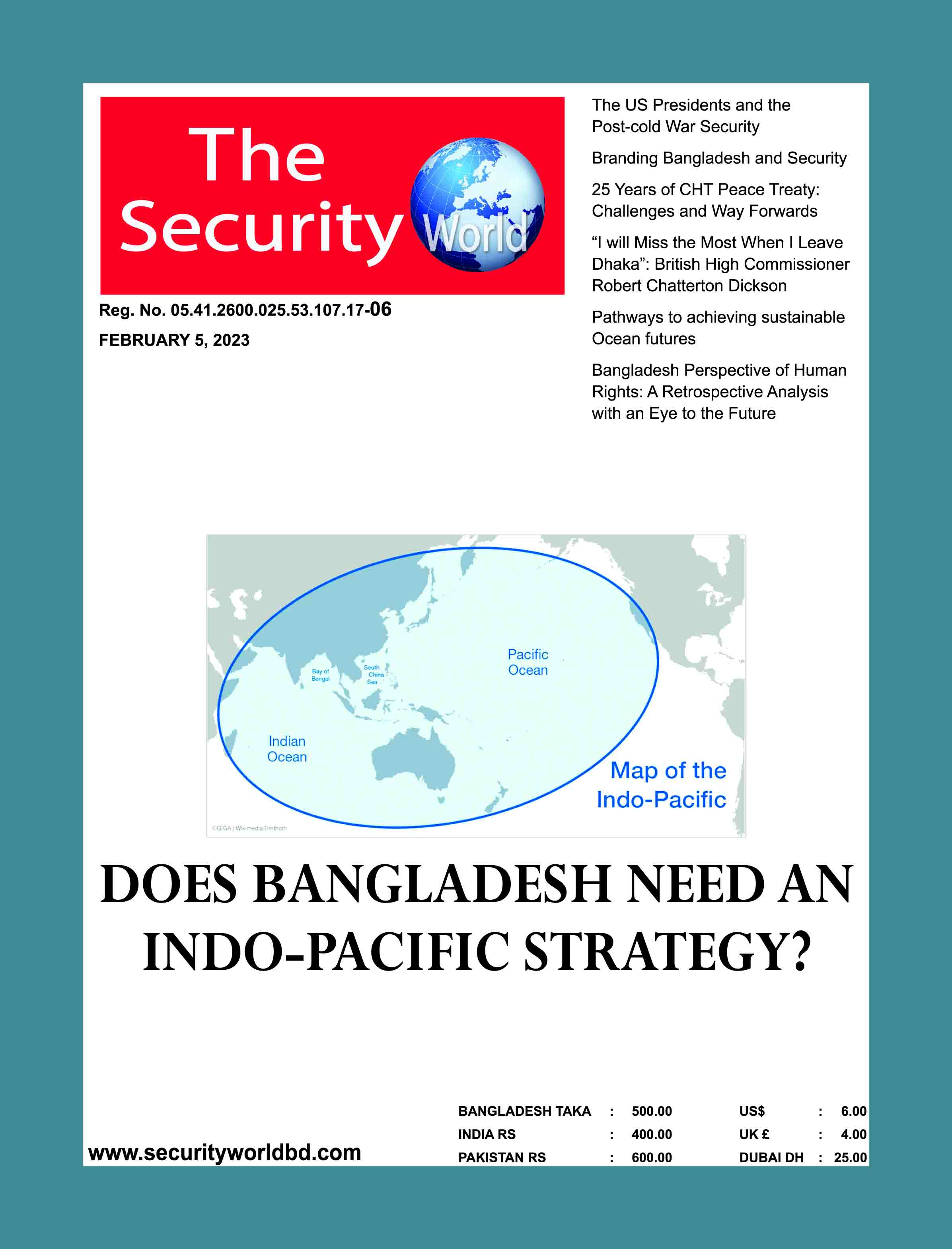
Does Bangladesh Need an Indo-Pacific Strategy?
📝
🕐 2023-02-04 17:56:05

Commodore Kazi Emdadul Haq (Retd)

Introduction
Bangladesh has become the seat
of discourse amidst the great powers' competition in the Indo-Pacific. Visits
by the newly appointed Chinese foreign minister at midnight and high-level US delegations
created curiosity among journalists and interlocutors. Social media, Twitter,
television, and interlocutors have built up the visits with lots of
speculations, passing comments and views from their points of interpretation.
Intellectuals and YouTubers
are trying to interpolate the logic of great powers' confluence in Bangladesh and
the connotation of the Indo-Pacific Strategy (IPS). The visits from the US and
China to Bangladesh after the adoption of the UNSC Resolution on Myanmar on 21
December 2022 have given rise to many theories of unresolved issues that placed
Bangladesh in a geopolitically crucial position.
Amidst this media hype, Bangladesh's foreign minister realised the need for a “strategy” for the Bay of Bengal (BoB). Does Bangladesh need a strategy? If so, why? We need to analyse from the perspective of Bangladesh and, at the same time, the US policy towards Bangladesh.
Indo-Pacific Strategy of the
United States
Before making a strategy, it needs a careful study of the Indo-Pacific approach of the United States. The United States generally pursues Bangladesh and other littoral countries to participate in Indo-Pacific roles. The crucial point is that the US-led IPS has not been known to sign or invited any countries to join, contrary to the China-led Belt and Road Initiative (BRI). China invited the nations to join and sign BRI. On the other hand, IPS is a strategy or concept in which the United States desires countries to participate in the Indo-Pacific affairs and uphold the "Free and Open Indo-Pacific (FOIP)" policy.

An airfield, buildings, and structures on the artificial island built by China at Subi Reef. Ezra Acayan/Getty Images
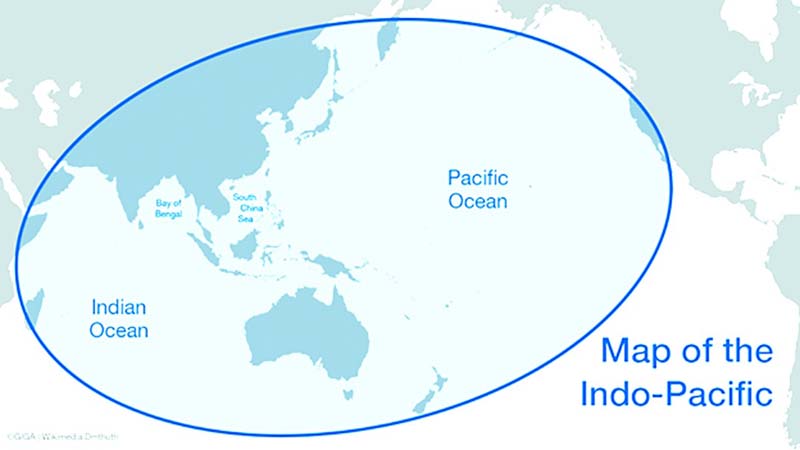
The IPS of the United States, February 2022, proclaims that the Indo-Pacific region stretches from the US West Coast to the Indian Ocean without clarifying the north and southern boundary. However, Canada’s Indo-Pacific Strategy states that the region encompasses 40 countries, including Bangladesh and landlocked countries Bhutan and Nepal. China is included in the region, but surprisingly Canada and Russia, or any other countries on the East Coast of the Pacific, were not included in the IPS, although littoral to the Pacific. Ideally, the US should welcome all countries of the Indo-Pacific to play a powerful role in upholding the FOIP policy. The very establishment of the Indo-Pacific concept has become obscure to comprehend.

Buildings and structures on the artificial island built by China at Fiery Cross Reef in the Spratly Islands. Ezra Acayan/Getty Images
The IPS has five
objectives (Page: 7) which target three areas to focus on: FOIP,
security, and economy. However, the majority of thinktanks would agree that
China is claiming almost all of the South China Sea (SCS) by drawing a 9-dash
line and seizing control of islands (mainly Spratly and Paracel) in the SCS, coercing
the United States into countering China through some strategy which later came
out to be the IPS. The United States advocates all countries of the region have
equal rights and “Freedom Of Navigation Operations” (FONOP) in all the seas of
the Indo-Pacific according to the "United Nations Convention on the Law of
the Sea (UNCLOS), 1982”.
China also alienated most Association
of South East Asian Nations (ASEAN) by pushing the 9-dash line into their
Exclusive Economic Zone (EEZ). The United States, its allies, and partners saw
this as China's unlawful aggression in the SCS and started FONOP in the SCS to
challenge China’s territorial claim. As such, China considers the IPS a policy
of the US containment of China. So the great power competition between China
and the United States has pushed the neutral littoral countries to choose the
sides to support.
Most Asian countries are
hesitant to participate in IPS due to fear of China’s economic retaliation.
Because in the last two decades, China engaged most Asian countries with
substantial financial investments under the banner of BRI, and they know the
severe consequences of withdrawing China's support.
Action Plans of the United
States
The United States has also outlined
action plans in IPS to implement the US strategy. The aggressive advocacy of
the United States is to strengthen ties among the "allies" and
"partners" of the Indo-Pacific region through various programs and
bilateral agreements.
To achieve the objectives of
the Indo-Pacific, the United States sporadically enforced forums, like, Quad (Quadrilateral
Security Dialogue), AUKUS(Australia, United Kingdom, United States), IPEF(Indo-Pacific
Economic Framework). Although not mentioned explicitly, these are the elements
of IPS to achieve the US objectives. In addition to these forums, the United
States also pursues countries to make military cooperation by signing
agreements with GSOMIA(General Security Of Military Information Agreement) and
ACSA(Acquisition and Cross Servicing Agreements). The
United States made GSOMIA agreements with 76 countries and ACSA with over a hundred countries worldwide,
including India and Sri Lanka.
Indo-Pacific is a vast
region where logistic support is a prime concern while US ships are away from
homeport. Through these aforementioned agreements, the United States
effectively strengthened the partnership; thus, it helped achieve the
objectives of IPS, mainly to wean
the neutral countries away from Chinese influence and carry out uninterrupted
FONOP.
Indo-Pacific Strategy of
Other Countries
Many countries brought out their Indo-Pacific strategy unitedly, rather than individually. Nations prefer inclusive Indo-Pacific, which means all littoral countries to be included, contrary to the intent of the United States towards China. Although most ASEAN countries are not very happy with China's 9-dash line, the ASEAN forum wants the Indo-Pacific to be inclusive of China. ASEAN has named the concept "outlook on the Indo-Pacific" based on the principles of strengthening ASEAN centrality. Similarly, the EU also brought out the "EU strategy for cooperation in the Indo-Pacific", in place of an individual strategy per country. In South Asia, such an initiative has yet to be taken either by SAARC (South Asian Association for Regional Cooperation) or BIMSTEC (Bay of Bengal Initiative for Multi-Sectoral Technical and Economic Cooperation).

Donald Lu in Dhaka. Source: PID Bangladesh
Indian Prime Minister Modi does
not want to see Indo-Pacific as a “strategy” or directed against
any country, and he launched Indo-Pacific
Oceans Initiative (IPOI) in 2019, where he used "ocean initiative"
instead of “strategy”. Great economic powers like Canada and Japan also brought
out strategies separately.
The central message of all
of the Indo-Pacific concepts is believed by many to ensure freedom of
navigation (rules-based order), security, and economic prosperity through
shared participation by all, which is similar to the IPS of the United States.
Instead of an individual
approach, countries preferred a collective one that conveyed a powerful message.
The major controversy of IPS among the countries is appeared to be simmering
over a single issue which is “inclusive” or “exclusive” of China. Specifying
this inclusivity/exclusivity in the doctrine could be fatal for weak developing
countries of the Indo-Pacific, for which these countries abstained from making
such doctrine individually.
It is not obligatory for nations to make such a doctrine to achieve interests in the Indo-Pacific. As more than 90% of Bangladesh's goods flow through BoB, safeguarding Sea Lines of Communication (SLOC) would be the immediate concern of Bangladesh. For that purpose, Bangladesh might need a strategy in the near future, which the Bangladesh foreign minister has expressed, "we will also have our own strategy on how we want to see our Bay of Bengal and beyond".

China's new Foreign Minister Qin Gang meeting with Bangladesh FM Abdul Momen. Source: Twitter/@BDMOFA
The Bangladesh Navy mainly
operates in the BoB but goes beyond during “goodwill visits" or for
carrying out exercises with friendly navies. Bangladesh Navy has put up its
best effort to make a maritime strategy for a long time. The "Forces Goal
2030", an ambitious plan to modernise Bangladesh Armed Forces, has
outlined the maritime strategy, which may further broaden.
Indo-Pacific Strategy and
its Impact on Bangladesh
Let's look at the IPS of the
United States, and where it placed Bangladesh to achieve US objectives. Is
Bangladesh included as a US partner or an ally?
The partnership is less formal than an alliance, also called a
"strategic partnership". The United States has five treaty alliances
in this region: Australia, Japan, the ROK, the Philippines, and Thailand. The
US strategy categorically mentioned the US leading regional partners are India,
Indonesia, Malaysia, Mongolia, New Zealand, Singapore, Taiwan, Vietnam, and the
Pacific Islands.
Where is Bangladesh? Despite
the fact that the United States is Bangladesh's number one export country and
third largest trading country, Bangladesh is not a partner of the United
States. Is the United States treating Bangladesh in the same category as
Myanmar? If so, why?
In fact, the relationship
between the United States and Bangladesh is like a "stepbrother" (unofficial
comment by a US diplomat where I was present), and it has remained like this
since the birth of Bangladesh till today. Former US President Richard Nixon and
his secretary Henry Kissinger did not want an independent Bangladesh. Even
after the independence, the legacy of Nixon continued in Bangladesh.
After coming to power, the Biden
administration didn’t invite Bangladesh to US President Joe Biden's
Summit for Democracy, held in December 2021. In contrast, Pakistan was invited
to that summit, but after a year, Biden described Pakistan as the "most
dangerous country” in the world.
The United States was
supposed to impart sanctions against India under
CAATSA (Countering America’s Adversaries Through Sanctions Act)
for buying the S-400 missile system from Russia, but later the US exempted
India from CAATSA; India continued buying Russian oil and gas at a subsidised
rate which helped maintain Putin's economy during the Russian invasion of
Ukraine; still, India remained the leading partner of the United States and
consented to India as a net security provider in the Indian Ocean.
To fulfill the "Forces Goal 2030", Bangladesh cannot buy
military equipment from the United States unless Bangladesh
signs two defence agreements with the United States: GSOMIA and ACSA. The US officials termed them
"foundational agreements" meant to strengthen defence relationship
between the two countries.
Although seething with
bitterness, Bangladesh may have to accept these realities and endure some unwanted
advice without pointing fingers at the United States’ problems at home. Due to its
economic engagement with the United States, Bangladesh must maintain its
support; perhaps, both countries have that understanding. The United States also
supports Bangladesh through various programs. In September 2022, cohosted by both the US Army and Bangladesh
Army, the 46th Indo-Pacific Armies Management Seminar (IPAMS) was
held in Bangladesh, where 23 nations’ senior army officers gathered.
Many conversationalists
postulated that the United States invited Bangladesh to join Quad; this was, in
fact, false. Quad members never invited any countries to join in Quad, let
alone Bangladesh – it is a farfetched idea of interlocutors. It was also an
inapt comment by the Chinese ambassador to Bangladesh to warn
Bangladesh not to join in Quad. Even the United States did not invite Bangladesh
to the Indo-Pacific Economic Framework (IPEF), launched on 23 May 2022 in Tokyo
by Joe Biden.
Despite the facts above, the United States wants to see Bangladesh
participate in various Indo-Pacific roles.
UN Resolution on Myanmar
Another bizarre idea floated
by some writers is establishing
a no-fly zone over Myanmar. This idea became popular among the
readers, especially after the UN Security Council adopted Resolution
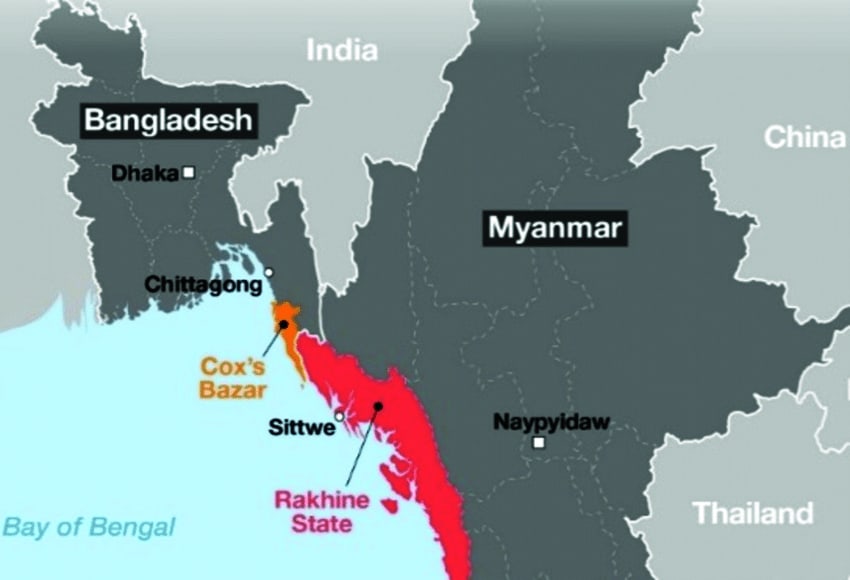
2669 on Myanmar on 21 December 2022, which
contains clauses related to Bangladesh that says to "create conditions
necessary for the voluntary, safe, dignified and sustainable return of Rohingya
refugees” (Serial 10 of the Resolution). Twelve votes adopted the resolution in
favour, and as usual, China, India, and Russia abstained.
The United States is clearly
recognising the looming threat for the Indo-Pacific region, expressed in the
resolution: “underlining the risks that the Rohingya situation poses for the
wider region”. Although this adoption of this resolution does not imply any end
to the Rohingya crisis because to take further action, UNSC needs to pass
another resolution where both China and Russia would come with their mighty
"veto" power.
Following the adoption of
the resolution, it became popular
discourse in the media on the issue of recent past visits from both the United
States and China. It is implausible that the United States would take any
actions in Myanmar, like invading Iraq, bypassing the UNSC approval. The US
intention appears to be balanced, not alienating ASEAN.
The recent visit to
Bangladesh by US Assistant Secretary of State for South and Central Asian
Affairs, Donald Lu desires Bangladesh to participate perhaps aggressively in
Indo-Pacific affairs. However, his
visit, followed by China's new Foreign Minister Qin
Gang’s brief stopover in Dhaka on 10 January 2023, had anything to do with
that is yet to unfold. But the meeting at midnight between two foreign
ministers has raised eyebrows among the thinkers.
Conclusion
Indo-Pacific is not a club
that Bangladesh can join; rather, it is a US strategy where the United States
always invites littoral countries, including Bangladesh, to participate in
various roles, and Bangladesh’s response is reasonably fair.
It also appears that
Bangladesh would not want to make any move that would be perceived as colluding
with the present relationship between Bangladesh and China. Bangladesh ought to convey a strong message
in line with the foreign policy of Bangladesh – “malice towards none” – that
the engagement with both China and the United States is for the economic
interests of Bangladesh and not to drag Bangladesh towards the great powers'
competition.
The Indo-Pacific Strategy of
the United States remains obscure to many, and they believed it to counter
China. Making a doctrine based on an opaque
IPS would be a daunting task for Bangladesh and could be counterproductive. At best, it would be a prudent idea to make
some strategy for the Bay of Bengal, instead of the whole Indo-Pacific, in line
with the maritime interests of Bangladesh.
Commodore Kazi Emdadul Haq,
BSP, ndu, psc, BN (Retd), Founding Member, Bangladesh Institute of Maritime
Research and Development (BIMRAD).








More News From This Category