Matarbari Deepsea Port: A Strategic Chess Match Unfolds in Bangladesh
📝
🕐 2023-05-13 06:49:00


Commodore Kazi Emdadul Haq (Retd)
Prologue
Bangladesh is again at the centre of a heated debate over the Japan-led Matarbari Deepsea Port construction, which would connect Indian Northeast states with the Indian Ocean. The significance of this port is insurmountable in the Indo-Pacific which placed Bangladesh under a myriad of uncertainties due to the great powers’ coercive diplomacy to sway Bangladesh in their favour, respectively. Indian media and some think-tanks view the Matarbari Deepsea Port as a triumph of Quad (Quadrilateral Security Dialogue) and a success against China-led BRI (Belt and Road Initiative).
India is reconfiguring it’s Indian Ocean strategy to prevent China’s convergence in the Bay of Bengal (BoB). It would otherwise fulfil the objectives of Quad and thus allowed Quad to establish a strategic foothold to counter China. Bangladesh finds it hard to maintain neutrality amidst the confluence of great powers in the BoB. Recent activities postulate that Bangladesh started oscillating between the East and West. Prime Minister Sheikh Hasina accused the United States of meddling in the internal affairs of Bangladesh, but after a couple of weeks, making a U-turn, the announcement of Bangladesh’s Indo-Pacific Outlook (IPO) and the strategic partnership agreement with Japan, Bangladesh is back at the forefront of media discussions.
It advocates that there exists a conflict of interests in the region which compelled all great powers to converge in the BoB focusing primarily on Bangladesh. How Bangladesh will maintain its well-ingrained foreign policy adage: “friendship to all and malice towards none”, is a matter to unfold.
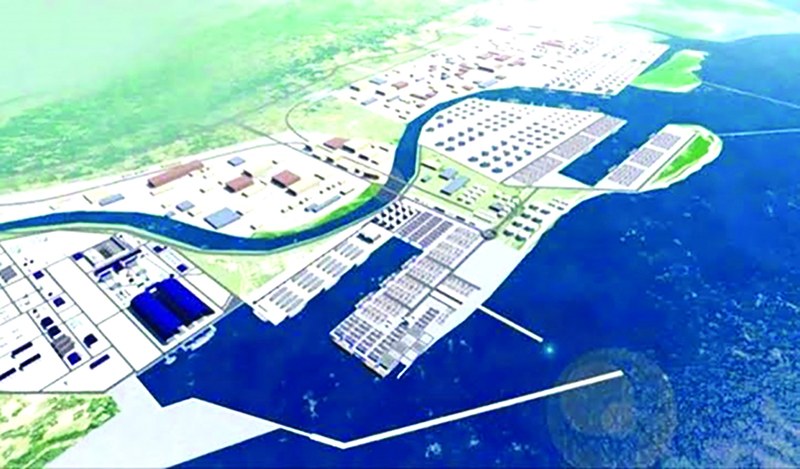
Matarbari Deepsea Port
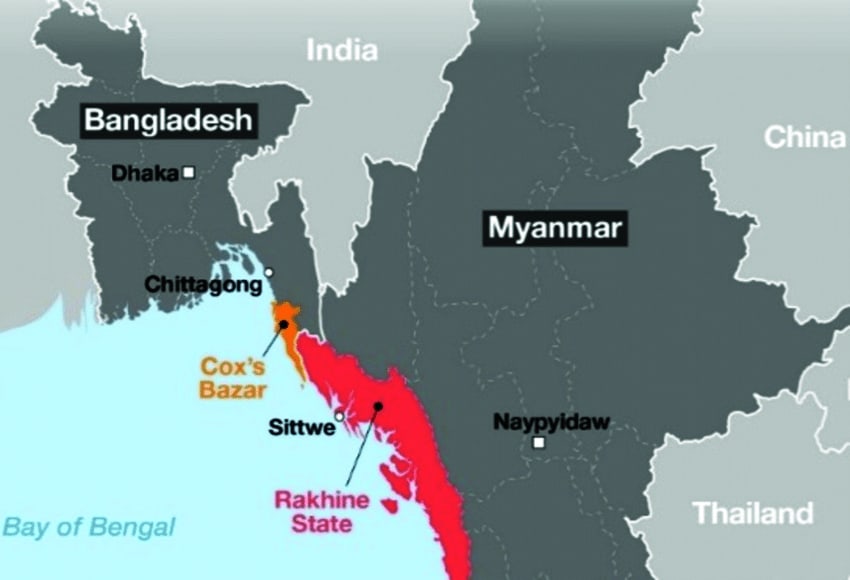
Bangladesh has needed a deep-sea port for many years, as large ships could not enter Chittagong Port. Bangladesh allowed China to conduct a feasibility study for making a deepsea port at Sonadia for many years, but under Indian coercive diplomacy, Bangladesh had to change its decision. Finally, Bangladesh awarded the contract of Matarbari Port, which is only 25 KM north of Sonadia, to Japanese firms in September 2020.

Kaladan Project, Courtesy: The Print
Matarbari Deepsea Port will have enough depth to allow ships of 18-meter draft to enter the port. The port will facilitate similar ships that enter the Port of Colombo or Port of Singapore, which means a considerable cost reduction for Bangladesh on feeder’s vessels to and from Singapore. The overburden on Chittagong Port will also ease.
The Matarbari port will undoubtedly provide fantastic connectivity to the Indian Northeastern States, known as the “Seven Sisters”. Indian political commitments of ‘Act East’ policy and “people-to-people connectivity” would be fulfilled to a greater extent through this port. India was trying to connect this underdeveloped hinterland region with the BoB through the Kaladan Project that started in 2010. However, the project was hung in limbo due to various complexities, such as its 110km road needing to be constructed through an ethnic conflict-prone zone and, on top of that, 158 km of Kaladan River needing to be navigable at all times. Such perilous journey through this Kaladan route cannot be a profitable one for the businessmen. Besides, ethnic conflict in the region may offer a serious security threat.
On the 20th March 2023, while visiting India, Japanese PM Fumio Kishida said in the 41st Sapru House Lecture, “…we will promote the Bay of Bengal-Northeast India industrial value chain concept in cooperation with India and Bangladesh to foster the growth of the entire region”. The following month, the same Japanese desire was reflected at the Japan-Bangladesh Joint Statement on Strategic Partnership on the 26th April 2023 in Tokyo, which was signed while Bangladesh Prime Minister Sheikh Hasina visited Japan. The two consecutive events signal the preamble a bigger game of great power competition. The strategy seemed well planned, which ignited discourse.
Quad Nexus and Bangladesh
Although the Quad idea – a four-party alliance of Australia, India, Japan, and the United States – was initiated by Japanese former Prime Minister Shinzo Abe in 2007, the Quad did not gain much traction mainly due to Quad members’ disinterest at that time as they gave more importance to improve the relationships with China. However, later when China became more assertive in the Indo-Pacific region and China attacked India at the Ladakh border in 2020, members realised the requirement of the Quad alliance, and India became a very active member of the Quad.
India prefers its archrival China to remain away from the Indian Ocean, which India considers their backwater and a net security provider. Fortunately, India’s policy in the Indian Ocean is very well in favour of the US-led IPS (Indo-Pacific Strategy). And Quad is one element of IPS which aims to achieve the IPS’ objectives. Matarbari Port has provided India a platform to alleviate some regional issues around BoB, which are desirous objectives of the IPS in many ways.
First, India and many maritime strategists consider China to have encircled India through China’s so-called “String of Pulse”. Japan-led investment in Matarbari Port was considered a diplomatic win for India to disrupt the String of Pulse. If China could obtain the contract for Matarbari port, it would offer an excellent advantage for PLAN (Peoples Liberation Army, Navy) to operate their naval vessels and protect Chinese fishing trawlers in the BoB.
Secondly, the economic growth in this region, as committed by Japan, is seen as the success of Quad. The US-led IPS defined Quad as a cooperative framework to deal with the non-traditional security that includes economic security in Indo-Pacific. Despite India being labelled as “shaky’ by President Joe Biden, the United States need India to counter China. It could be why the Japanese PM said, “India is indispensable for peace and stability in the Indo-Pacific”.
Finally, Nikkei Asia said the port would provide a strategic anchor for Japan and India. It means the port would become an anchor for Quad as well.
Bangladesh is not a party to Quad and was never invited to join by any members. However, it appears that Quad members are interested in achieving the objectives of Quad utilizing the geopolitical position of Bangladesh. So, all contesting parties including China started all forms of diplomacy with Bangladesh to secure an advantage.
Despite casting votes in favour of Russia on many UN resolutions, Bangladesh was under heavy Russian criticism for its decision to ban Russian ships from calling at Bangladeshi ports, for which the Bangladeshi ambassador was summoned to the Russian foreign ministry. Previously, China’s ambassador warned Bangladesh not to join Quad (which is an absurd example of Chinese wolf warrior diplomacy). China also would not be happy with Matarbari Port being given to Japanese firms.
The United States also kept Bangladesh under diplomatic pressure by imposing sanctions on some personnel of the army and police and expects some political agendas to be fulfilled. The PM of Bangladesh possibly became annoyed and outburst her righteous indignation in parliament on the 10th April 2023 against the United States, saying, “the United States can overthrow the government in any country….”
Neighbouring India’s sphere of influence appears more exhaustive and guileful. One hundred seventy million people of Bangladesh believe that India will exert some influence over Bangladesh as a regional power but expects to follow the manners and etiquette according to international relations.
Indian Home Minister termed Bangladeshis as termites and threw them into BoB, which created anti-Indian sentiment among many Bangladeshis. Indian media is also very aggressive against Bangladesh. An article published in the Indian Express, “Bangladesh on razor’s edge: Why India must wake up to the looming economic crisis and political instability to its east”, written by Avinash Paliwal; another article published in Swarajyamag, Dragon Breathing Down India’s ‘Chicken’s Neck’: Why This Chinese Project In North Bangladesh Is A Grave Security Threat; these are few examples of the Indian media’s attitude towards Bangladesh. Feeling apprehensive and frustrated, Bangladeshis at home remain unvocal about their concerns.
Some of these writers are suggesting what to do and what not to do within the politics of the Bangladeshi government, then suggest, if necessary, intervention by India. On the contrary these writers have shown comparatively less interest in studying how China, which was once poor, became an economic superpower.
Strategy of Bangladesh
Bangladesh aspired to graduate from the Least Developed Countries (LDC) list by 2026, and its economy was also making steady progress through a cautious approach among the great powers. But the unfortunate dual events, Covid-19, followed by the Russian invasion of Ukraine, greatly affected Bangladesh. To sustain the burgeoning economy, Bangladesh needs great powers’ investment. In the pursuit of the economy along with political aspirations, Bangladesh may be tempted to succumb to great powers.
Amidst the great powers’ influence, Bangladesh announced its Indo-Pacific Outlook (IPO), followed by the Japan-Bangladesh Joint Statement on Strategic Partnership on the 26th April 2023. Due to the neutral approach, the IPO may not alienate any great powers. Like the ASEAN outlook, Bangladesh used the “inclusivity” of all Indo-Pacific nations. Although the IPS does not portray “inclusivity”, most Indo-Pacific nations and EU countries have used inclusivity, which otherwise implies the inclusion of China.
Also, it needs to understand the wording used in the US-led IPS: the United States prefers to use “US and its allies and partners” carefully, avoiding the term “multilateralism” which China staunchly prefers in the present days. The United States has mentioned many Indo-Pacific nations in their IPS, except Bangladesh; the Indo-Pacific Economic Framework for Prosperity (IPEF) launched in Japan in May 2022, omitted Bangladesh; the future decisions by the Bangladeshi policymakers should be given due diligence. The announcement of the IPO does not necessarily mean that Bangladesh has joined IPS. Bangladesh would be in a very awkward situation to exercise FOIP (Free and Open Indo-Pacific) in the South China Sea (SCS) if requested by the US.

However, the joint statement with Japan contains many contentious issues directly related between Japan and China, i.e., both countries have overlapping claims on the Senkaku/Diaoyu Islands in the East China Sea, interminable maritime disputes to resolve by UNCLOS, respect the rule of law, etc. As a signatory to UNCLOS, China claimed almost all SCS by drawing a 9-dash line over well inside the EEZ of littoral countries of SCS, giving no respect to the rule of law. China also rejected the international tribunal decision on the maritime dispute with the Philippines.
As such, the Japan-Bangladesh agreement is likely to affront China where China can retaliate in terms of economic coercions. The world has seen China’s wolf warrior diplomacy retaliate against Australia for simply enquiring into the origin of Covid-19. Australia and many Pacific nations feel the throes of China’s economic coercion. How Bangladesh is going to appease China is a matter yet to be unfolded.
On the Rohingya refugee issue, besides the United States, Bangladesh did not get much support from other Quad members. Although China is the archrival of India, on the Rohingya issue, China, India and Japan are in entente on espousing Myanmar SAC (State Administration Council) rather than resolving the security issue created by the ousted Rohingya people.
China, till now, invested USD 7 billion out of promised 26 billion but captured 23 billion contracts in different sectors of Bangladesh, which would surely echo China’s “debt trap” diplomacy. Is the time ripe for Bangladesh to lessen its dependence on China by announcing IPO and agreeing on such issues in a Japan-Bangladesh joint statement? It would be a major policy shift by Bangladesh towards the West.
The depicted above scenario posits that the US-China competition allowed the great powers to exercise influence over Bangladesh excessively, to achieve the objectives of IPS and their own national interests. It undoubtedly pushed Bangladesh to take a decisive role in the Indo-Pacific concept. Without being a member of Quad, Bangladesh became a playing field for Quad members.

Conclusion
Amidst the great power’s rivalry, the geopolitical position of Bangladesh has forced the country drawn into the chessboard of Quad and China. Bangladesh may turn this competition into opportunity if the strategic decisions are made correctly. Steering through tumultuous competition would be challenging but could be favourable if the people’s voices become united and heard. The fear is that the extreme diplomatic influences by the great powers may compel Bangladeshi government to take unwarranted political benefit in a quid pro quo, which would be a long-term detriment to the sustained economy to graduate from LDC.
Bangladesh may strife to take full advantage of Matarbari Deepsea Port, allowing all neighbouring countries, including landlocked countries Nepal and Bhutan. All efforts should be made to turn the port into a regional hub of port connectivity.
Great powers cannot expect a panacea from Bangladesh to appease all. Instead, Bangladesh gave all great powers the opportunity to invest.
Bangladesh should continue its present policy of engagement with favourable nations between the “US-led allies and partners” policy vs China’s “multilateralism” policy.
Commodore Kazi Emdadul Haq, BSP, ndu, psc, BN (Retd), Founding Member, Bangladesh Institute of Maritime Research and Development (BIMRAD).







More News From This Category