Myanmar’s Unfolding Catastrophe: A Boon for the Indo-Pacific Strategy
📝
🕐 2024-03-19 04:17:31

Commodore Kazi Emdadul Haq (Retd)
BSP, ndu, psc. Founding Member, BIMRAD.

Introduction
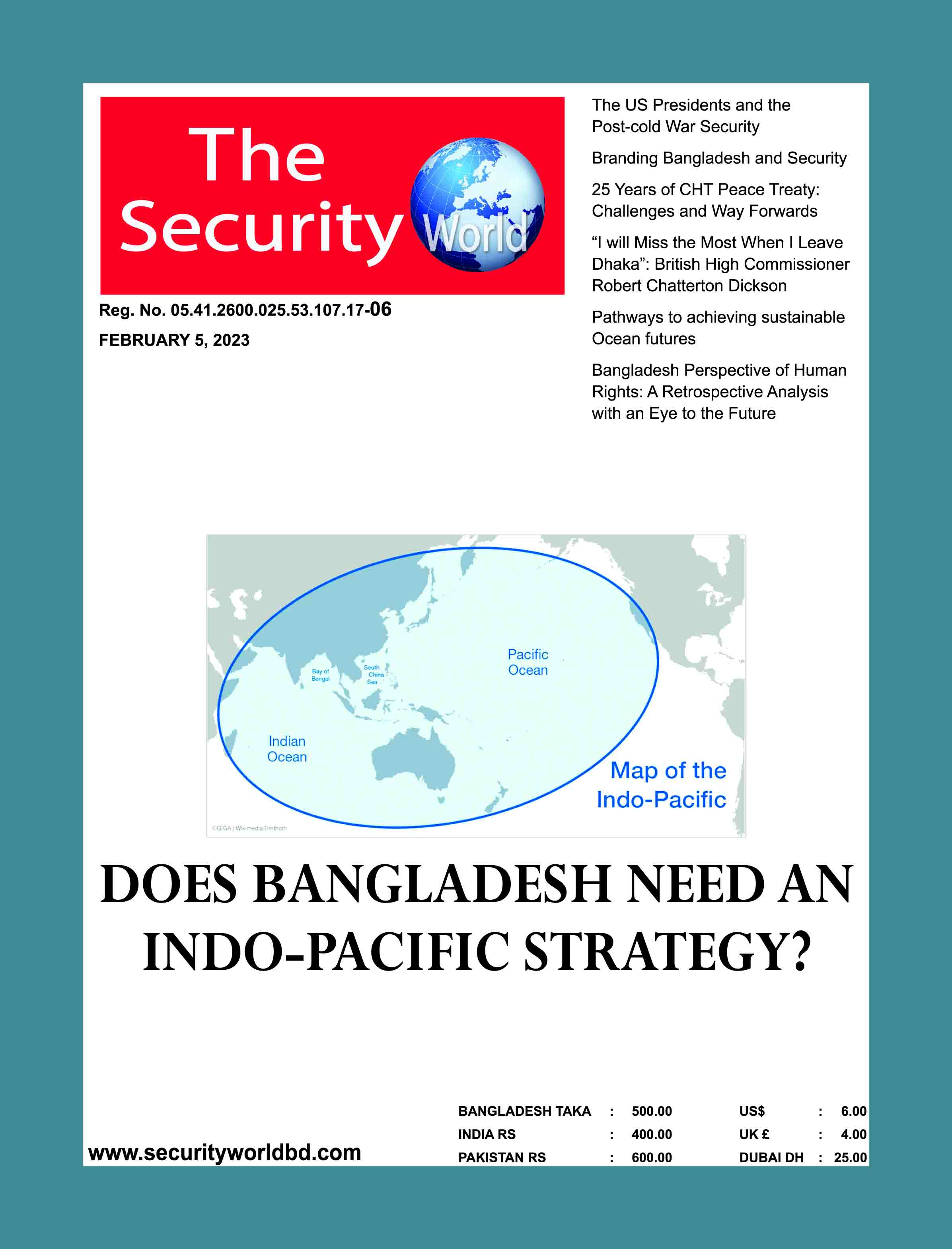
While the United States endeavours to maintain a simple aim with its Indo-Pacific Strategy (IPS), the nuanced implications of this approach have led to increased complexity in achieving its objectives. Despite the straight definitions attributed to the IPS by the United States, its underlying reality remains focused on curtailing or constraining China’s ascendance in the Indo-Pacific region.
China finds itself strategically encircled in the East by the United States and its allies, leveraging a network of military bases and U.S. fleets. China’s vulnerability through the Malacca Strait is well-known to all. China has long been striving to establish an alternative maritime route through Myanmar, where the presence of the U.S. is relatively minimal.
Scenario Unfolding in the Bay of Bengal Region
Gradually and inconspicuously, there have been sporadic geostrategic advancements in the BoB region. When these disparate occurrences are pieced together, it suggests that someone is orchestrating a grand scenario with finesse. To grasp the intricacies of this strategy, it is imperative to examine a few isolated developments, as outlined below:
A. Matarbari Deep-Sea Port
Bangladesh has long sought a
deep-sea port. For years, Bangladesh permitted China to conduct a feasibility
study for establishing a deep-sea port. However, under the influence of Indian
coercive diplomacy, Bangladesh was compelled to reconsider its decision.
Ultimately, in September 2020, Bangladesh
awarded the contract for the construction of the Matarbari Port,
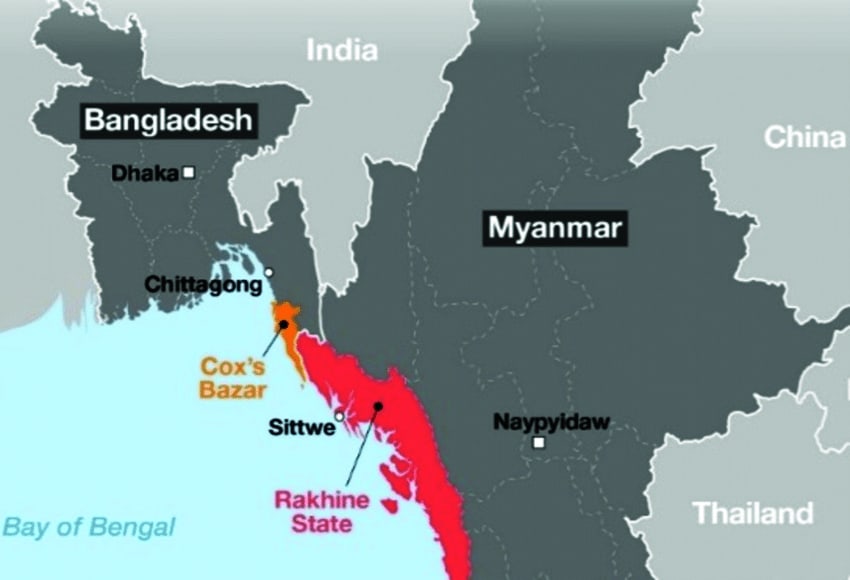
located just 200 kilometres north of Sittwe Port in Rakhine, to a Japanese
firm.
During his visit to India on
March 20, 2023, Japanese Prime Minister Fumio Kishida articulated
during the 41st Sapru House Lecture, "...we will advance the
concept of the Bay of Bengal-Northeast India industrial value chain in
collaboration with India and Bangladesh to stimulate the development of the
entire region." Subsequently, in April 2023, a similar sentiment was
expressed in the Japan-Bangladesh Joint Statement on Strategic Partnership,
signed in Tokyo during Bangladeshi Prime Minister Sheikh Hasina's visit to
Japan. Analysts suggest that the term "entire region" encompasses
connectivity to India's hinterland states, known as the Seven Sisters States
including Chin and Rakhine states of Myanmar. Given the sequence of these
events, coupled with Japan's close alliance with the United States, it suggests
the inception of a broader strategy aimed at fulfilling the objectives of the
IPS.
B. Seven Sisters States in Northeastern India
World Vision, an international
Christian humanitarian organization dedicated to combating poverty and
fostering development worldwide, operates extensively across the Seven Sisters
states. In regions such as Meghalaya, Nagaland, and Mizoram, where the
Christian population comprises 80 to 90 per cent, World Vision's presence is
particularly pronounced.
Considering the historical foreign policy stance of the United States, it is reasonable to anticipate that the United States would safeguard World Vision's initiatives and the Christian community, potentially through physical intervention in suitable areas.

C. Present Situation of Chin State, Myanmar
Chin State shares borders with
the Seven Sisters States and Bangladesh, with approximately 70% of
its territory now under the control of the Chin National Front
(CNF). With a Christian population exceeding 85%, Chin State is effectively
governed by the CNF. Rebel forces from both the Seven Sisters States and Chin
State collaborated to support each other's quests for independence, providing
refuge as needed. Culturally and religiously, the people of Chin share
similarities with those of Mizoram and a few other states of Seven Sisters.
The CNF has also forged alliances with the parallel National Unity Government (NUG) on both political and military fronts. Meanwhile, the Arakan Army, a member of the Three Brotherhood Alliance, is gaining control over Rakhine State, mirroring similar developments in various other states across Myanmar. This collective situation suggests an impending implode of Myanmar's governance.

D. Controversy Surrounding the St Martin’s Island
The leasing of St. Martin's
Island to the United States has sparked controversy, with Prime Minister Sheikh
Hasina of Bangladesh alluding to attempts by an unnamed entity—widely believed
to be the United States—to secure
a lease for the island. In my previous article titled "Controversy Surrounding
the Alleged Lease of St. Martin's Island," I dismissed the
notion that St. Martin's Island would make for a suitable base facility for the
United States due to its lack of defence in depth towards Myanmar's land.
However, recent developments in the western zone of Myanmar have altered this
perspective, as it now offers potential land-based support for bases on St.
Martin's Island.
By leveraging land-based
support, such as that from Chin State in Myanmar, the United States could
effectively neutralize air threats in the region. This suggests that St. Martin's
Island could indeed serve as a viable base for U.S. military operations,
contingent upon receiving support from Chin State.
The United States maintains a
significant presence with over 800 military bases in 70 countries, including
agreements such as the General Security of Military Information Agreement
(GSOMIA) and the Acquisition Cross-Servicing Agreement (ACSA). If leasing St.
Martin's Island to the United States proves to be mutually beneficial for
Bangladesh under appropriate terms and conditions, there may be no inherent
harm in pursuing such an arrangement. If China can maintain strong economic
relations with countries hosting U.S. military bases, such as Germany, then
there's no reason why China wouldn't continue its relations with Bangladesh
after leasing out St. Martin's Island to the United States.
Connecting the aforementioned facts presents a compelling
opportunity for the United States to potentially access or garner support from
the Christian community in establishing military base facilities aimed at
countering China's influence. Reflecting on the developments in Myanmar over
the past decade, it becomes evident that the situation has evolved dramatically
from what was previously anticipated.
The above scenario implies the creation of a corridor
whereby Chin State could be linked to the BoB via the Sittwe Port in Rakhine,
complementing the Matarbari Deep-sea Port. Importantly, such a connection could
embolden rebels seeking independence in the Chin State, potentially fostering a
larger community receptive to United States support for their autonomy. While
speculative, this hypothesis presents a highly plausible means to advance the
objectives of the IPS. According to many
strategists, it is widely perceived that making China less powerful is a
fundamental objective of the IPS, as articulated by Defense Secretary Lloyd
Austin's desire
to see Russia weakened.
Although the United States need the cooperation of India to
counter China, the “shaky”
relationship of India as a Quad partner, and its continued support towards the
Myanmar junta and Russian President Putin, all suggest that the United States
would be looking for a better strategic plan to counter China's influences in
the BoB region.
Since the assassination of Aung San in 1947, the father of
Aung San Suu Kyi, Myanmar's numerous ethnic groups have struggled to govern the
country cohesively. The deep-seated divisions among these ethnic groups have
hindered efforts to achieve unity and stability. With more than 2.6 million
displaced people, Myanmar has emerged as one of the most unstable countries in
the world. The current state of affairs in Myanmar suggests that the nation is
on a trajectory towards becoming a failed state or potentially facing
fragmentation along ethnic lines shortly. If it is so, the Christian community
will welcome the United States and without much effort, it offers the United
States a prelude to step into Myanmar to counter China.

Confluence of Great Powers
As the situation in Myanmar grows increasingly intricate,
any overt support from the United States in the region would inevitably attract
the attention of other regional and global powers. Recognizing this dynamic, it
appears that the United States has adopted a cautious approach, opting to
proceed slowly as the situation in Myanmar is unfolding in favour of the United
States. Furthermore, the United States
is currently preoccupied with Ukraine and Gaza, and hesitant to engage in
another conflict currently.
For years, China has sought to establish alternative Indian
Ocean connectivity routes as a contingency to the Malacca Strait, a critical
sea lane of communication (SLOC) for China. Aware of its vulnerability via the
Malacca Strait, China initiated the China-Myanmar Economic Corridor (CMEC)
through the Kyaukpyu Port in Rakhine State involving billions of dollars in
investment over multiple phases. China is not going to give up its vital
connectivity and will maintain it at any cost. To achieve its goal, China is
seen to supply both the Tatmadaw and rebel groups, particularly the Arakan
Army, with weapons, thus maintaining a dual strategy in Myanmar.
As a regional neighbor, India is deeply apprehensive about rebel control over both Rakhine and Chin States, fearing it could fuel separatist movements in the Seven Sisters states. Consequently, India is likely to oppose any external interference in Chin State.

The article "How
India Betrayed the Rakhine People – And Why It Matters Today"
underscores India's consistent support for the military junta in Myanmar and
its involvement in military operations against rebels. India's primary focus
lies in the Kaladan Multi-modal Transit Transport Project, aimed at connecting
Mizoram through the Sittwe Port in Rakhine, reflecting its significant
investment in the region.
Warnings
from the United States Assistant Secretary of State for
South and Central Asian Affairs, Donald Lu, to Dhaka and Delhi about the
deteriorating conflict in Myanmar have added to the complexity of the
situation. Such warnings could escalate tensions and have broader implications.
Given India's close ties with Russia, the reaction of Russia to these
developments remains yet to unfold.
The United States seems more successful than other sea
powers in revitalizing its economy and securing its interests globally,
prioritizing its own citizens' safety over the lives lost in Gaza or Ukraine.
Through persistent efforts, the United States has successfully persuaded NATO’s
European allies to increase defence spending to 2% of their collective GDP, a
move that will bolster the U.S. economy by benefiting American manufacturers.
With a strengthened economy, the U.S. may become more assertive in containing
China's influence in the BoB region.
Conclusion
President Joe Biden's emphasis on "putting America's
interests first" underscores the United States' willingness to pursue its
objectives globally. However, this approach often overlooks the fundamental
rights and interests of others, as evidenced by the situations in Ukraine and
Gaza.
While the United States may not perceive immediate threats
in the Bay of Bengal region, its commitment to the Indo-Pacific Strategy (IPS)
and countering China's influence suggests a strategic imperative to weaken
China. Given the Bay of Bengal's significance in the Indo-Pacific region, it is
inevitable that the United States will pursue its interests in advancing the
IPS objectives.
The unfolding situation in Myanmar especially the Chin
State appears to align with the broader strategy of the United States,
exemplified by the controversies surrounding the U.S. base on St Martin's
Island and the Matarbari Deep-sea Port. Unless part of a larger grand strategy,
such developments would not occur in isolation.
Serendipitously or coincidentally,
the overall situation in the Bay of Bengal region favours the United States to
establish its foothold in the region to counter China.









More News From This Category